
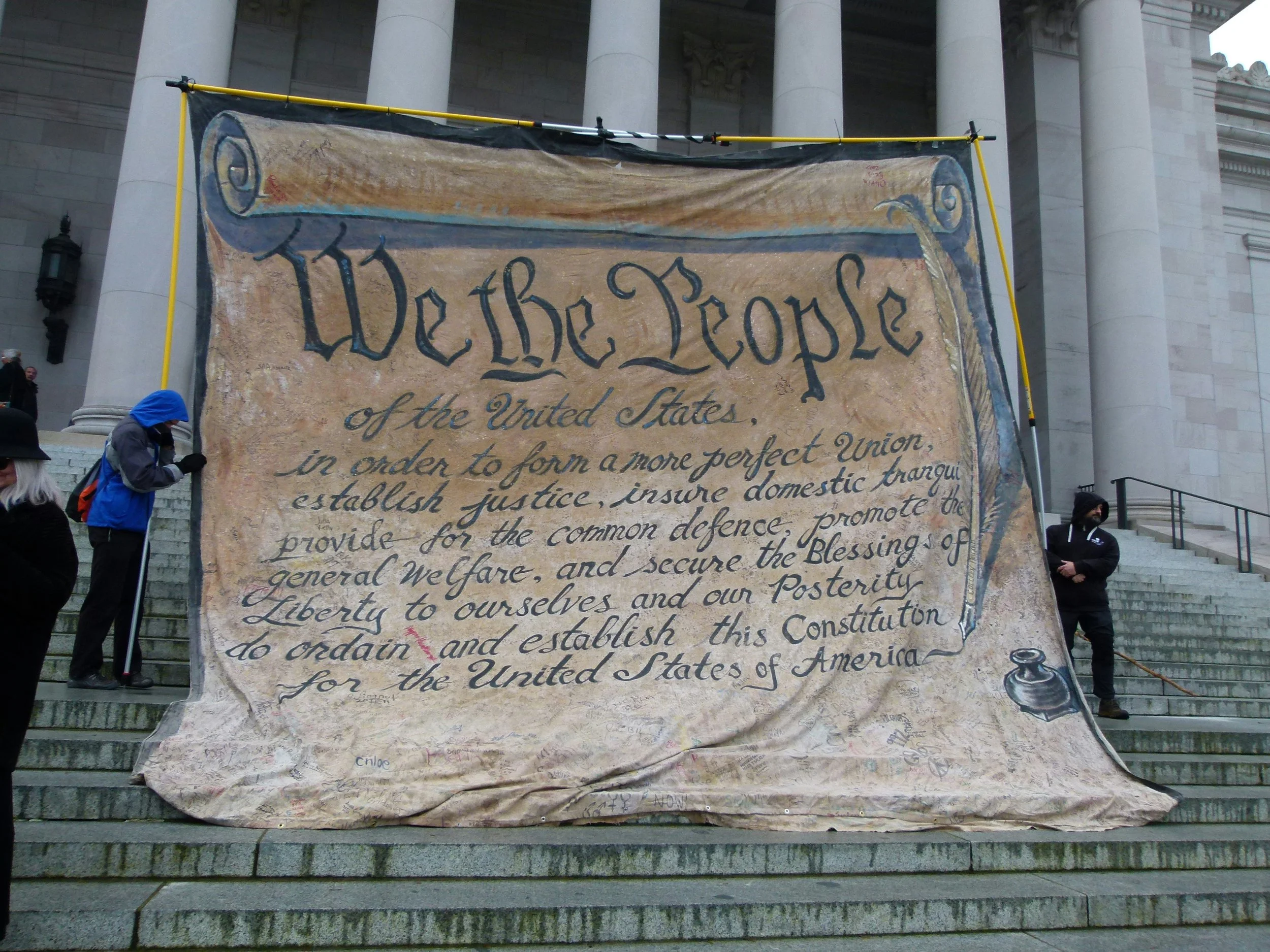
Making “We the People” Mean Something Again
In 1816, Thomas Jefferson complained about excessive reverence for the U.S. Constitution, saying that “laws and institutions must go hand in hand with the progress of the human mind.”
Without adapting to new conditions, “we might as well require a man to wear still the coat which fitted him when a boy, as civilized society to remain ever under the regimen of their barbarous ancestors,” Jefferson wrote.
It’s time to act on that spirit.
The Wiki Constitution Project is a public forum for reimagining a stronger and more robust U.S. democracy. The goal is broadening the debate and showing what American political institutions and processes could be.
Foundational Tenets
These are the basic principles that make the exercise of state power legitimate and serve as the guiding principles for the draft. Like everything in this process, they are open to constructive debate.

-
The state holds power in trust, not in its own right. Every office, institution and authority exists because the people have delegated power, and that power is exercised only under the terms of that delegation.
-
The rights of any single individual cannot be commuted by the will of the majority. Popular sovereignty is not a license for a tyranny of the majority. A constitutional order without safeguards offers no protection against power seized lawfully and then entrenched.
-
No entity — corporate, financial, or institutional — holds the rights of a person by analogy. (This tenet does not disturb the distinct political status of sovereign nations within the United States, which rests on treaty and nationhood rather than on individual privilege.)
-
As the steward of the people, the state has the duty to prevent the excess accumulation of power by any individual, entity or group. Regardless of whose hands hold it, power that gathers beyond effective challenge becomes unaccountable. A constitution that guards only against state power, while economic, informational and platform power concentrate unchecked loses substance.
-
Accountability requires enforceable constraint. Where a rule depends on the restraint of the person it constrains, it is not a rule.
-
Authority should be exercised at the most local level capable of exercising it effectively. Higher levels only act where lower ones genuinely cannot. Distance between a decision and its consequences is itself a form of concentrated power.
-
Free and fair elections are necessary and non-negotiable, but they are not sufficient. Deliberation, citizen assemblies, direct petition and other means of participation are legitimate parts of how a people governs itself. A constitutional order should provide for them in its design.
-
A fundamental law that cannot in practice be changed ceases to be a framework for self-government and becomes an inheritance imposed on the living by the dead. Hurdles for amendment are a legitimate safeguard; impossibility is a defect.

Here’s how it works
The project is designed to be of the people, by the people and for the people. Participation is organized around two roles:
Delegates do the actual drafting. Selection is vetted to ensure there’s a broad ideological range. This is not a partisan project. We’re not writing policy. We’re reimagining the rules of the game, and they should be fair for all the players.
Constituents are everyone else who wants in. Every draft, every clause, every proposed structure will be public and open to reaction.
Sign up below to get involved and stay up to date.